Artificial intelligence, data, and education
Connecting data, AI, and strategy to create tools and insights that drive impact

I am Success Areeveso, a data analytics professional and education researcher based in London.
My work sits at the intersection of data, AI, and education. I’m interested in one question above all: how do you use data and emerging technology to close gaps in education and access, not just describe them?
Where I started
I hold an MA in Education and Development with Distinction from the University of East Anglia, where I was an Allan and Nesta Ferguson Scholar. My dissertation investigated how university students use generative AI tools. Through 106 survey responses, eight interviews, and a focus group, I found that students were already using AI widely but without clear institutional policies, training, or ethical guidance to support them. That finding set the direction for everything that followed.
I also hold a B.Ed. in Education and Chemistry from the University of Benin, Nigeria, where I graduated in the top 5th percentile (CGPA 4.19/5.00) despite faculty strikes extending my four-year programme to five years.
What I do now
I’m a Data Analytics Fellow at Amdari, where I build interactive Power BI dashboards from real business datasets and run structured projects on demand forecasting, funnel analysis, and customer churn. One recent project was a funnel analysis for an EdTech platform that led me to build a Conversion Impact Simulator showing how targeted fixes at two stages of the user journey could more than double the platform’s conversion rate.
I have developed proficiency in SQL, Python, Power BI, DAX, and Excel through Tritek Consulting, DataCamp, and Udacity, and I continue to publish data analytics projects on this site and on Medium.
What I build
After presenting at the University of Cambridge’s Generative AI in Education Conference in October 2025 on designing digital advocacy campaigns for inclusive AI, I published a 38-page open-source Digital Advocacy Campaigns Toolkit with a 7-step framework, worksheets, and tracker templates. It has been downloaded over 100 times across 10 countries.
I also created Advocacy Studio (advocacy-studio.vercel.app), an AI-powered web application that helps educators, nonprofit leads, and community advocates design ethical advocacy campaigns. I conceived the product, designed the user flow, and wrote the product requirements. Version 2 guides users through defining a problem, mapping stakeholders, and shaping a SMART goal, with Gemini AI generating first-draft content that users can refine and export as a PDF.
Recognition
I am a Salzburg Global Fellow on the 100 AI Champions initiative, where I moderated a session on the Current Reality of AI in Education at the Future of Teaching programme in Salzburg, Austria, authored the official launch feature article, and co-facilitated an AI Champions session at the Learning Planet Festival.
At the Cambridge GenAI Conference, I delivered a session, facilitated breakout workshops, and was invited onto a panel on geopolitical challenges to inclusive and equitable AI in education.
I also contributed to the Sviesa Think Tank’s roundtable debate on Creativity, Education & AI, which informed the published white paper Redefining Creativity in the Intelligent Age.
What’s next
I’m building my technical skills so I can deliver decision tools and data-driven insights that create real impact. I want to build things that help organisations make sharper decisions about who they serve and how they reach them.
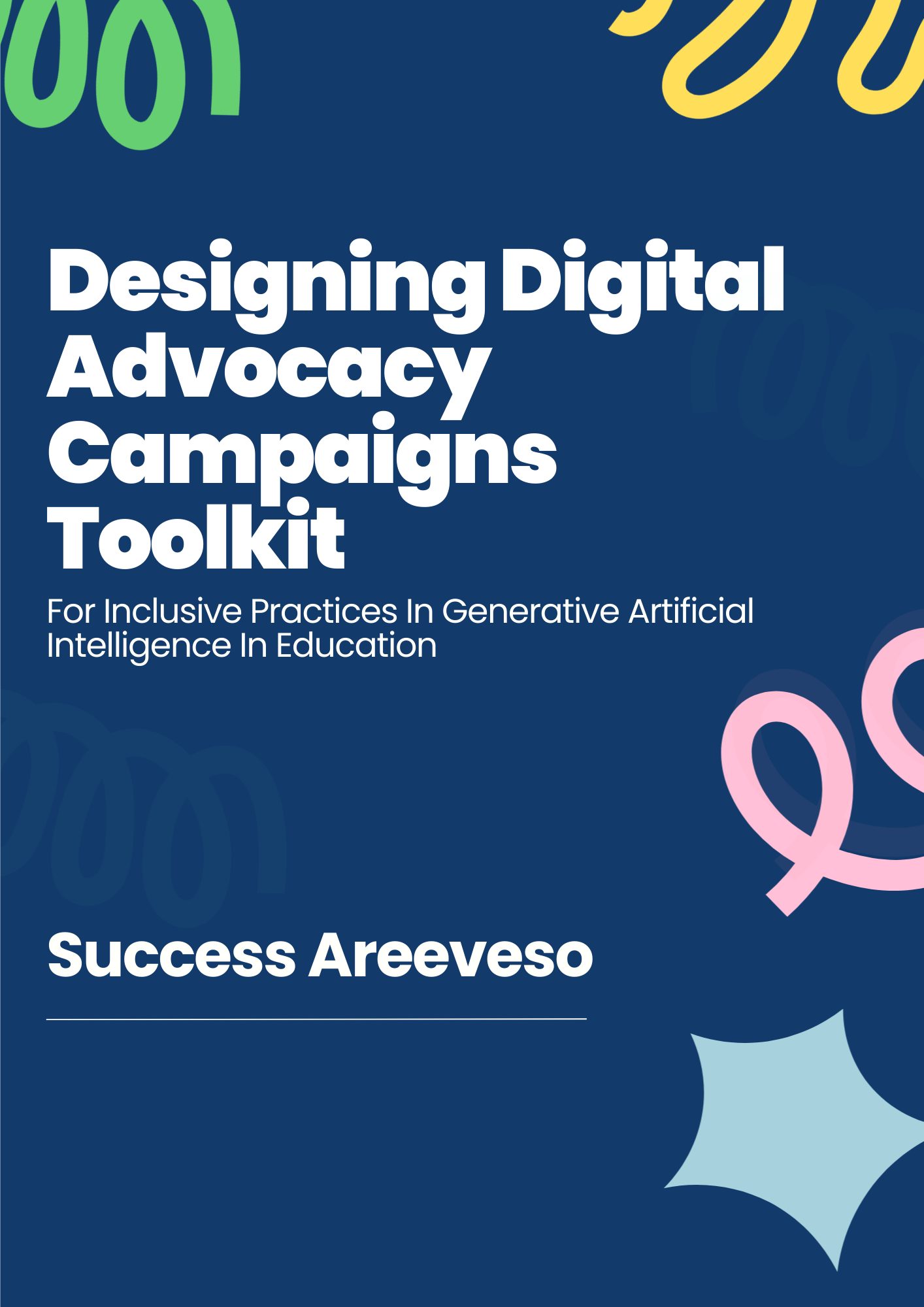
digital advocacy toolkit
Designing Digital Advocacy Campaigns Toolkit
I created this toolkit after my presentation at the Cambridge Generative AI in Education Conference (27–29 October 2025) because I kept hearing the same need: people don’t just want to be told that generative AI is changing education. They want practical ways to shape how these tools are created and used, so change happens with communities, not to them.
Designing Digital Advocacy Campaigns for Inclusive Practices in Generative AI in Education is a step-by-step guide for turning concern into action. It helps young people, educators, institutions, and communities build inclusive, realistic digital advocacy campaigns without needing a big budget or a large team. The toolkit centres three core inclusion priorities: Access, Bias, and AI Literacy, and it uses a straightforward seven-step campaign-building process that takes you from defining the problem and who it affects, to identifying your audience, choosing platforms, shaping your story, setting a SMART goal, and tracking progress.
To make the toolkit even more usable, I also created a companion no-code AI campaign builder app that guides users through the same seven steps and generates a campaign plan and a first draft of a social media post. Together, the toolkit and app support a conversation-driven, accessible, and grounded-in-real-educational-contexts advocacy, helping people start small, iterate quickly, and build momentum toward more inclusive, generative AI practices in education.